How to humanize ChatGPT text?
To humanize ChatGPT text, scan the draft, then run one pass in ClearScript instead of asking ChatGPT to rewrite itself. On a 303-word essay I tested, the free check read 76% AI, the full report 98%, the rewrite prompt still 98%, and the rescan after one humanizer pass read 5% AI, marked Human.
On this page
You already have the draft open in another tab, and it is a little too clean. I ran one real ChatGPT draft end to end for this guide; the wider set is the bench test of 8 AI humanizers.
The guides ranking for this search teach edits on invented examples, and not one of them shows you a score. So I generated a real ChatGPT essay and kept every number from October 16 and 17, 2026.
The essay runs 303 words, argumentative, on the claim that social media does teenagers more harm than good, with zero style steering. You'll know the glue when you see it. Your topic can differ, but the loop is the same.
Scan the draft before you rewrite it.
The free check gives you the score; the sentence report sits behind a plan.
Why does ChatGPT text get flagged?
ChatGPT text gets flagged because it runs on one rhythm, leans on stock glue and picks safe words that never risk a weird choice.
The opening of my draft is the specimen.
Although social media allows teenagers to communicate and express themselves, it does more harm than good.
That is a concession and a pivot in one breath, both sides covered, safe on purpose. A detector matches patterns and has no interest in your manners, and this particular pattern is common.
I scanned all 303 words on the public checker.
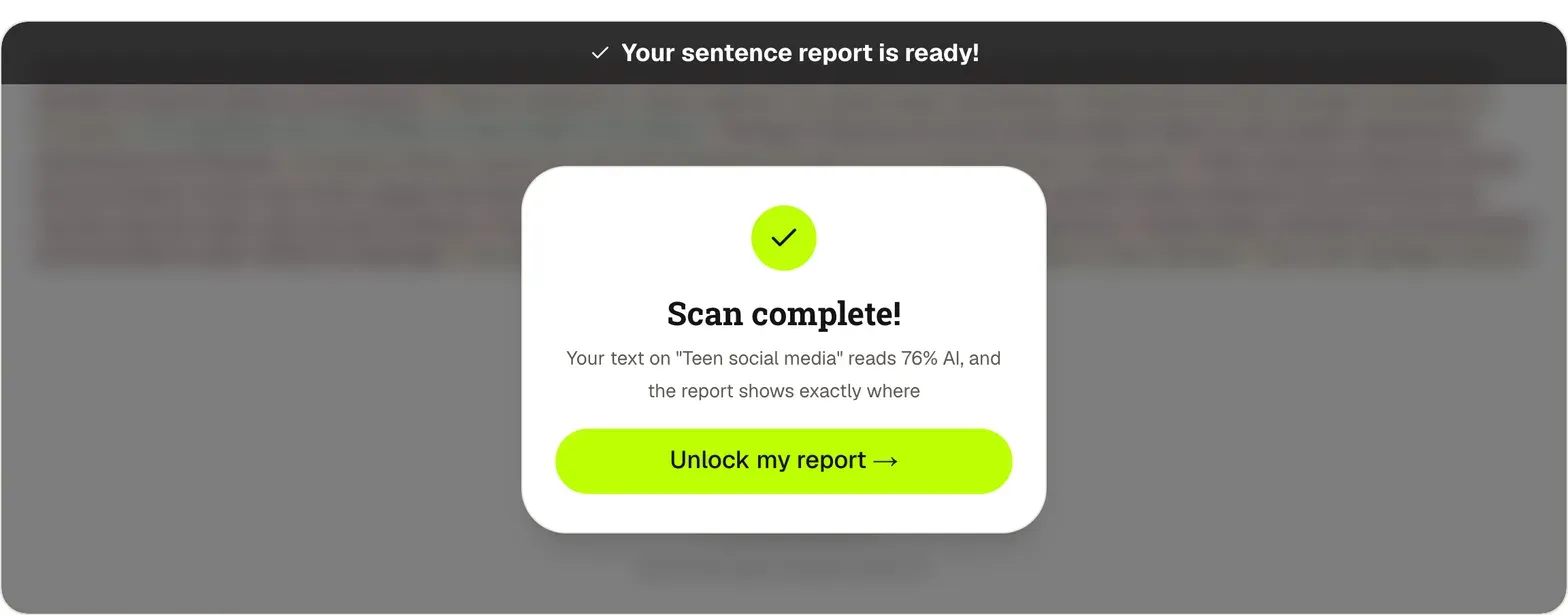
76% AI, and gated: you get the score, while the sentence report locks behind a plan (I wanted the lines).
The full report sits in the paid workspace.
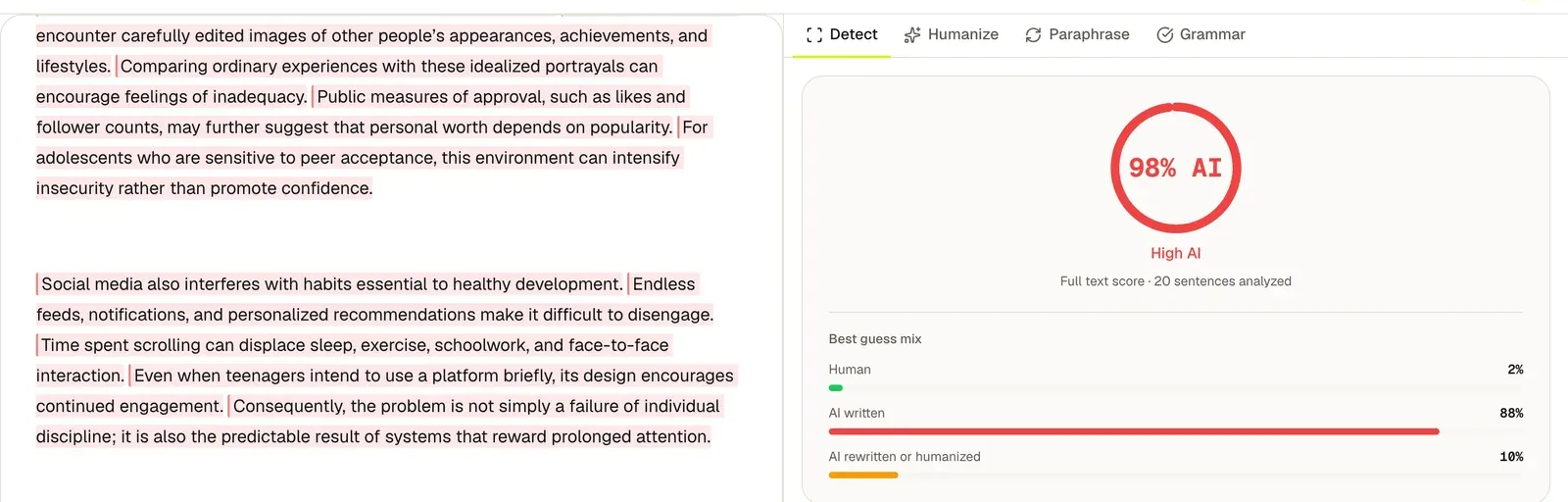
98% AI there, 20 sentences, 19 flagged high and 1 mixed, the whole page washed red. Nobody had edited the draft, and with almost every sentence still matching, sanding one line was never going to be the fix.
The raw paragraph further down is the close-up. "One significant harm is" labels the point instead of making it, "Frequently" ducks, and "May further suggest" stacks a hedge on a hedge. None of those words is wrong on its own. The uniform is the problem.
A draft like this one earns its score. As for the gap between 76% and 98%, I won't invent a cause: same essay, same two days, and both numbers are shown.
Can you just ask ChatGPT to humanize it?
Asking ChatGPT to humanize its own text didn't work when I tested it: the rescan stayed at 98% AI.
I pasted the raw draft back into ChatGPT with this prompt.
Rewrite this text so it sounds more human and natural, as if a person wrote it. Vary the sentence lengths, remove robotic transitions, keep the meaning and every point.
The rewrite read smoother, and I rescanned it. Still 98% AI.
The model is re-rolling the same dice. It can't see its own fingerprint, so a request to sound human just draws again from the same pile. If you came for the prompt, there it is, and 98% is the receipt. Rewording the request won't give the model eyes, and that is the trouble with every prompt recipe for this: none of them can see the fingerprint either.
How to humanize ChatGPT text with a tool that works
To humanize ChatGPT text with a tool, run one pass in a humanizer and then rescan; that is what moved this draft. I ran ClearScript on Auto tone, Balanced strength, one pass.
-
Scan first and note the flagged sentences. On this draft, 19 of 20 were high, plus 1 mixed. On the free check you only get the score, so write it down before you edit.
-
Pick tone and strength on purpose. Auto keeps your voice, Balanced is the default, and I used both. A louder strength is a different test, and this result does not transfer to it.
- One pass, then read it against the original for facts, names and figures. The tool does not get to invent a study. My draft had none, so I checked the claims instead.
Before (raw draft):
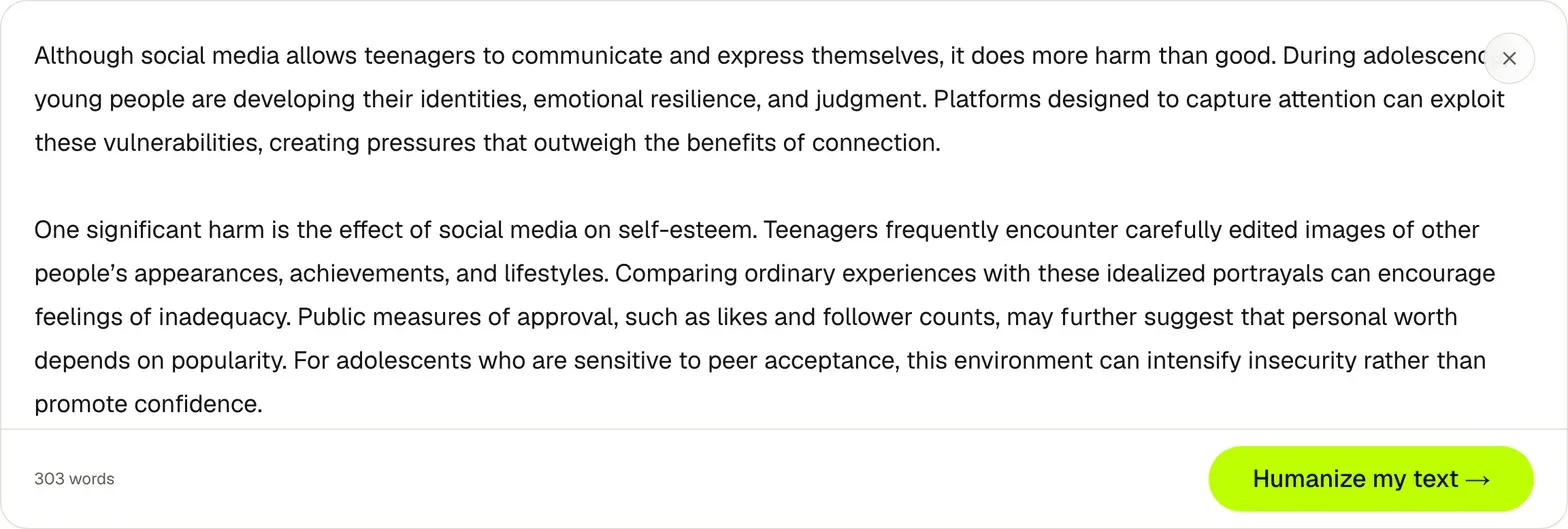
One significant harm is the effect of social media on self-esteem. Teenagers frequently encounter carefully edited images of other people's appearances, achievements, and lifestyles. Comparing ordinary experiences with these idealized portrayals can encourage feelings of inadequacy. Public measures of approval, such as likes and follower counts, may further suggest that personal worth depends on popularity. For adolescents who are sensitive to peer acceptance, this environment can intensify insecurity rather than promote confidence.
After (one pass later):
The clearest damage shows up in self-esteem. Teenagers scroll past a steady stream of other people's best moments: edited photos, filtered achievements, lifestyles staged for an audience, and measuring an ordinary Tuesday against all of that tends to breed a sense of falling short rather than anything resembling confidence. Then there's the public scorekeeping, the likes, the follower counts, and the message becomes hard to miss: your worth is a number, and other people get to set it. For kids who are already anxious about where they stand with peers, which is most kids at that age, this doesn't build confidence. It does the opposite.
Same claims after the pass: edited images, likes, follower counts, peer anxiety, and no new number. The shape moved, and so did the length, from 303 words to 498, which I would not call a win; those extra lines now have to earn their place.
- Rescan in the same account.
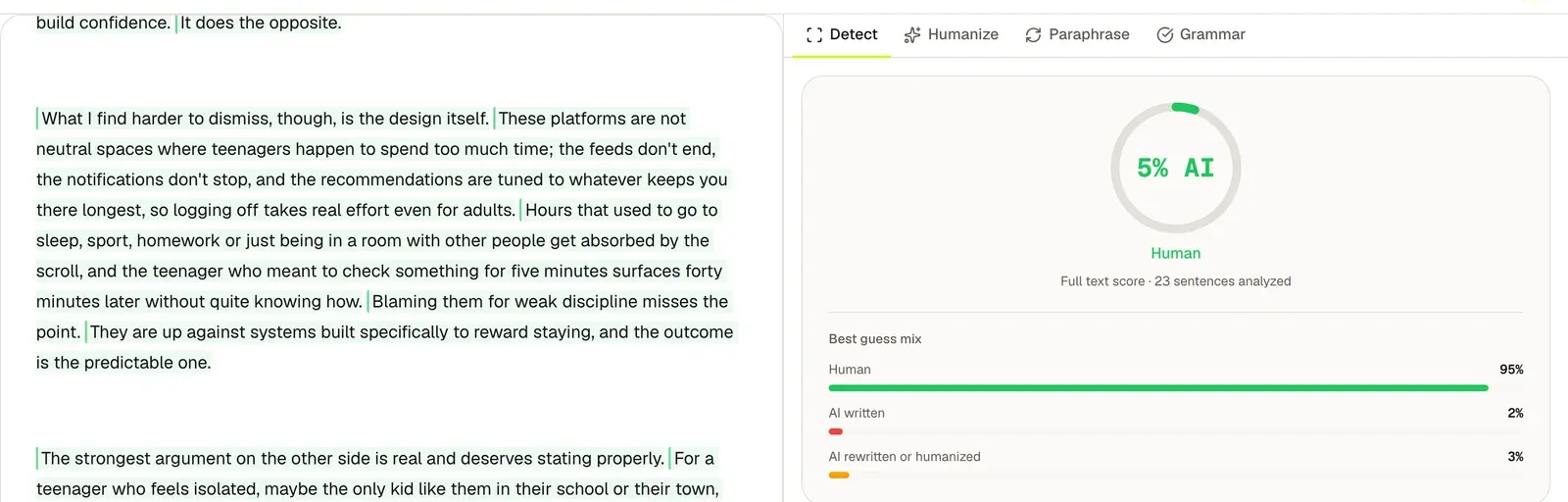
The rescan read 5% AI, labeled Human, high confidence, 23 sentences, a 95% human mix.
- Add one thing only you know: a line from class, this week, or an objection your teacher already raised. A pass moves rhythm and structure. It doesn't invent your experience, which is why step 5 exists.
One pass, then the rescan.
The full report read 98% AI. After the pass it read 5%. Your draft will not match.
What do the hand edits add?
Hand edits add the calls a model will not make, and these four come from lines in this draft.
Kill the stock glue. "One significant harm is" labels the harm instead of stating it, and "Consequently" and "Ultimately," showed up as hinges, grabbed whenever the draft wanted to sound done. Cut them and the next sentence has to earn the turn on its own.
Break the rhythm. Raw sentences march at one width, and that even march is a flag by itself (the before paragraph is five sentences of nearly the same length). So split one, and let another run long, past where a model would stop.
Add what only you know, a line from your class or from this week, since I cannot write it and a tool cannot honestly invent it. If the only concrete detail in the paragraph came from the pass, you still have a generic paragraph.
Then read it aloud. The line that sounds like a press release is the one to rewrite, and here that was the opening. If you would not send a sentence to a friend, it is not finished.
What do the free options get you?
The free humanizer options get you a short run (QuillBot), a suite you may already have open (Grammarly) or a no-signup pass (Clever AI Humanizer), but not the full loop on a whole draft.
| Tool | What you get free |
|---|---|
| QuillBot | Free humanizer capped at 125 words a run. A suite staple, light touch. |
| Grammarly | Free with an account. Four preset styles, plus a custom voice from a writing sample. Six languages. |
| Clever AI Humanizer | Free with no account, up to 3,000 words a run. The no-signup option. |
QuillBot is the paragraph tool: 125 words a run on the free humanizer, light touch, so a 303-word essay means more than one trip. Grammarly makes sense when the account is already open anyway, with four preset styles, a custom voice built from a writing sample and six languages. Clever AI Humanizer is the no-signup option, free up to 3,000 words, which covers a full student draft in one run.
The loop above is a different job, because it wants a rescan you can open yourself, on the whole draft, without slicing it into 125-word pieces. Rewrites on ClearScript start at $4.99 for 7 days, and the figures sit on the plans. The scan is free and the rewrite is paid, so know which step you are paying for.
One pattern from the bench test of 8 AI humanizers is worth repeating here: the cautious tools keep your meaning and your score, and the aggressive ones move the score and eat the meaning. The free tiers above sit on the cautious side, by design.
FAQ
What is a ChatGPT humanizer?
Can ChatGPT humanize its own text?
Does humanized text pass Turnitin?
Is a humanizer the same as a paraphraser?
Can I humanize ChatGPT text for free?
Is humanizing ChatGPT text cheating?
Will Google penalize humanized AI content?
The receipts, and the one caveat
| The draft | The scan |
|---|---|
| Raw, straight off the chat | 76% AI on the free check; 98% AI in the full report, 19 of 20 sentences flagged high |
| After ChatGPT's own "make it human" rewrite | Still 98% AI |
| After one ClearScript pass, Auto and Balanced | 5% AI, Human, high confidence, 95% human mix |
A score is an estimate, not a verdict. The test that matters is your own paragraph, read against what you meant and then scanned again.
Put your draft through the same loop.
Scan it, run one pass, then read before you submit.