
Is GPTZero accurate?
GPTZero is accurate enough to flag AI text and not accurate enough to prove anyone used it. The independent RAID benchmark puts its catch rate at 95.7% on clean AI text, while false positives concentrate on non-native writers, formal academic prose and short texts. Treat the score as a signal, then get a second opinion.
On this page
A score shows up and a grade, an application or a job starts to tilt on it. The number looks exact, and the person who wrote the pages never got a hearing. I've read those emails, from students and from teachers who don't want to accuse the wrong person.
GPTZero catches obvious machine text. It also flags formal human prose, which is why its score shouldn't convict anyone. I wrote a passage for this post, scanned it and kept the result; it's further down, dated and unrounded.
A score surprised you? Get a second opinion.
The free check marks the exact sentences that read machine-written, no account or card.
What do GPTZero's own numbers say?
GPTZero's own claims put accuracy at 99%+ on pure AI text, and its own 3,000-text benchmark reports 99.3% accuracy with 0.24% false positives. Mixed documents in that vendor record sit at 96.5%. The company reports more than 19 million registered users and about $30 million in annual recurring revenue, and its partnership with the American Federation of Teachers puts the checker in classrooms. Superhuman, Grammarly's parent company, announced the acquisition on June 23, 2026.
Those figures are the vendor's, on the vendor's sets, and I don't read 99.3% as the chance that your essay was machine-written. A pure AI sample and a formal student paragraph are different jobs for a detector.
What comes back is a probability with sentence highlights, and the free scan is a thinner pass than the advanced report with its full sentence breakdown. I checked the product pages on October 16, 2026, and the free pass is capped well below it.
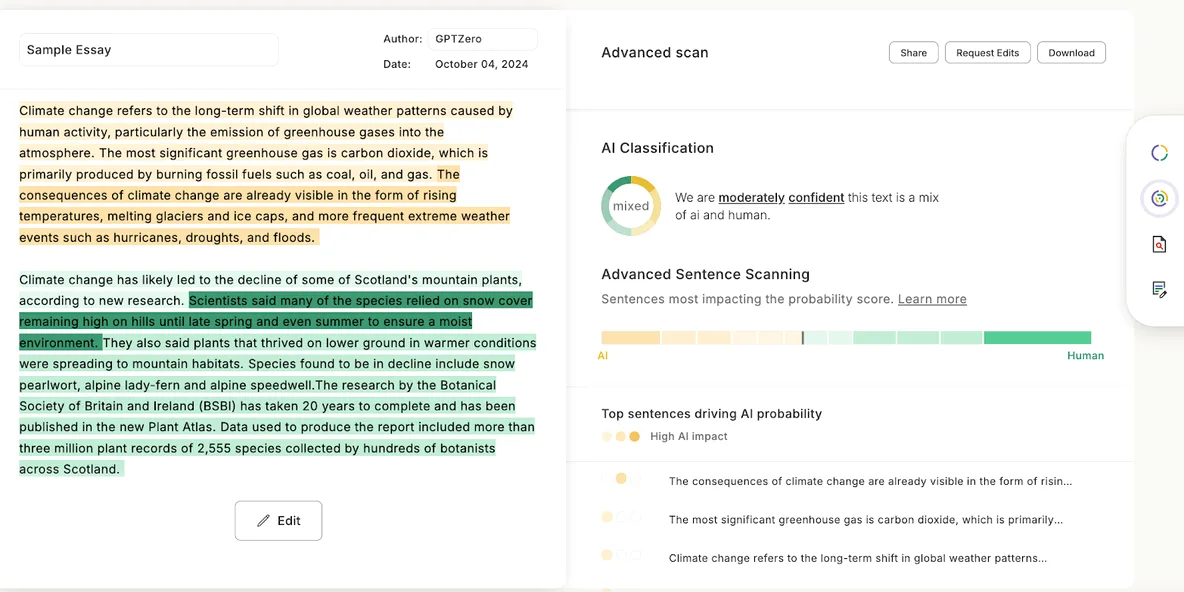
How accurate is GPTZero on clear AI text?
GPTZero is very accurate on clean, obviously machine-written text: the RAID benchmark, independent and cited by GPTZero itself, detects 95.7% of AI text at a 1% false-positive rate without adversarial attacks. On some generators that rate drops to 0.81-0.87, and SpeedAI sits at the top of that table at 0.995. Stanford SCALE 2025, on 78 essays, caught AI text at 90-99%. Epoch AI 2026 recorded 0 false positives for GPTZero on 495 clean human texts, and found that detectors miss AI that imitates real authors. Bloomberg 2023 found 1-2% false positives on 500 pre-AI essays.
Raw ChatGPT text is the strongest ground, since an untouched model dump is exactly what these tools were built to catch, and if a draft still sounds like that a high score is the ordinary result. The misses show up when the text is shorter, more edited, or written to sound like a specific person. That is why I keep Epoch's imitation finding next to the 95.7% figure. A leaderboard without attacks says little about an edited student draft.
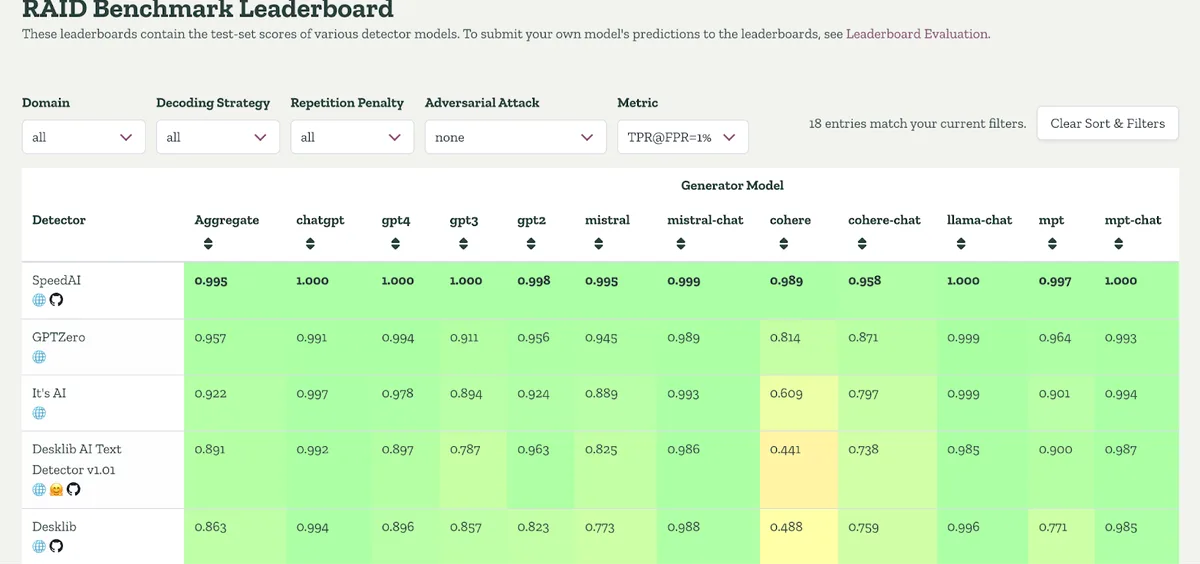
Where does GPTZero get it wrong?
GPTZero's errors cluster where it hurts: non-native writers, formal academic prose, short texts, and some specialist writing.
Stanford 2023, Liang et al. in Patterns, tested seven detectors including GPTZero on 91 TOEFL essays by non-native writers, and across the seven, 61.3% of those essays were flagged as AI on average. 89 of 91 were flagged by at least one detector, 19% unanimously, while native-speaker essays in the same study came back mostly clean. That average covers all seven tools and shouldn't be read as this detector's solo error rate.
Popkov and Barrett 2024, in Accountability in Research, found the free GPTZero marked a median 27.2% of human-written academic text as AI-generated. Formal register, on its own, raises the odds of a flag.
Stanford SCALE 2025 saw human essays fluctuate, and texts under about 350 words flagged more, which makes a short discussion post a worse sample than a full paper (for the writer and for the tool).
Cureus 2023, on medical texts, reported GPTZero at 10% false positives and 35% false negatives. Specialist prose can look off to a general detector and still be human, and the false-negative side matters too, because a clean score clears nothing by itself.
Reddit users report the same text scoring 100% human on one run and 100% AI on the next. That's anecdote rather than a benchmark, but it lines up with what the studies see. When a rerun jumps like that, slow down and read the text instead of the number.
Doe v. Yale, filed in D. Conn. in February 2025, is still an allegation: a French-born EMBA student flagged by GPTZero was suspended and sued, alleging bias against non-native speakers. In May 2025, The New York Times covered students having to prove they did not use AI. A complaint and a news story are not settled science, and I include both anyway, because students are living inside this.
| Source | Sample | What it found | What it does not prove |
|---|---|---|---|
| GPTZero's own benchmark | 3,000 texts | 99.3% accuracy and 0.24% false positives; mixed documents 96.5% | A vendor test of the vendor's tool. Not the hard cases below. |
| RAID | Independent benchmark, no adversarial attacks | 95.7% of AI text at a 1% false-positive rate; 0.81-0.87 on some generators; SpeedAI at 0.995 | Performance on clean AI text. Not non-native or formal human prose. |
| Stanford 2023 | 91 TOEFL essays; seven detectors including this one | 61.3% flagged as AI on average across the seven; 89 of 91 flagged by at least one; 19% unanimously; native essays mostly clean | A solo error rate. The 61.3% is a seven-detector average, not this detector alone. |
| Popkov & Barrett 2024 | Human-written academic text | The free tool marked a median 27.2% as AI-generated | Every plan, every genre, or the single essay in your inbox. |
| Stanford SCALE 2025 | 78 essays | AI text caught at 90-99%; human essays fluctuated; texts under about 350 words flag more | A large or stable human false-positive rate. |
| Cureus 2023 | Medical texts | 10% false positives, 35% false negatives | Results outside medical prose. |
| Bloomberg 2023 | 500 pre-AI essays | 1-2% false positives | Today's formal or non-native drafts. |
| Epoch AI 2026 | 495 clean human texts | 0 false positives; detectors miss AI that imitates real authors | The hard human cases. Clean human text is the easy side. |
Flagged and sure you wrote it?
Paste the text into the free check and see whether a second detector agrees, sentence by sentence.
Is GPTZero accurate in Spanish?
No study in this record measures GPTZero's accuracy in Spanish, and multilingual detection sits behind Premium; the free scan is English-tuned. Independent evidence outside English is nearly nonexistent, which is why I won't print a Spanish accuracy figure. For a second read in another language, ClearScript checks nine languages, including Spanish and Brazilian Portuguese.
Is GPTZero free?
GPTZero is free with caps: on the vendor's own pages, checked October 16, 2026, the free plan allows 10,000 words a month, 10,000 characters per scan and 1 free advanced scan, and an account is required. A free flag still deserves a second read.
How much does GPTZero cost?
GPTZero Premium costs $23.99 a month or $12.99 on annual billing, and Professional is $45.99 or $24.99; I checked both prices on October 16, 2026, on the vendor's own pages. Annual billing saves about 45%. Multilingual detection is a Premium feature, which is why a free English scan cannot answer the Spanish question above.
| Plan | Price | Words a month | What it adds |
|---|---|---|---|
| Free | $0 | 10,000 | 10,000 characters per scan, 1 free advanced scan, account required |
| Premium | $23.99 a month, or $12.99 a month billed annually | 300,000 | Multilingual detection |
| Professional | $45.99 a month, or $24.99 a month billed annually | 500,000 | Batches of 250 files |
GPTZero vs Turnitin: which score should you trust?
Neither GPTZero nor Turnitin should be trusted as proof. Turnitin lives inside school accounts, GPTZero is a standalone checker anyone can open, and both produce signals. The institution stays responsible for the judgment, whatever the percentage says. Neither publishes a like-for-like public test against the other, so no honest scoreboard exists, and a school dashboard and a public website can disagree on the same file. When they do, read the prose and the drafts rather than picking the harsher number.
What should you do if GPTZero flags your writing?
If GPTZero flags your writing, get a second opinion from an independent detector, humanize only the flagged sentences, re-check the rewrite, and keep your drafts.
- Get a second opinion on an independent detector, to see whether the verdict repeats and where. The free ClearScript check marks sentences, asks for no account or card and does not cap the number of runs, and the text is deleted after the run.
On October 16, 2026, I scanned a 214-word formal passage on congestion pricing, written by a person for this post, on the free ClearScript check. It reads 4% AI, and the sentence report shows its work line by line. The studies above explain how a GPTZero-class detector treats formal prose like this, so the second read is there to settle one thing: whether a careful instrument agrees.
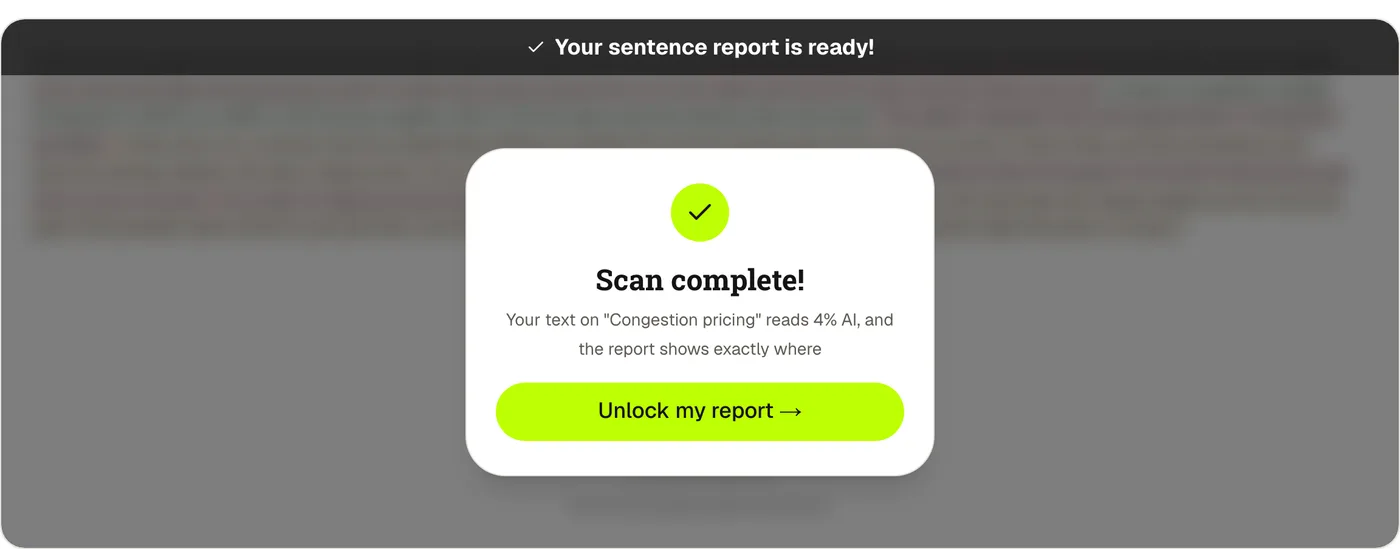
Formal human prose is exactly the kind of writing the record above flags, and on this check it reads as what it is, written by a person.
- Humanize only the flagged sentences with the humanizer. Facts, names and citations stay put, and access starts at $4.99 for 7 days. Leave alone the paragraphs that already sound like you. If you wrote the piece you are repairing a false read; if you did not, no rewrite makes a false authorship true.
Rewrite only what got flagged.
The humanizer moves the robotic sentences and leaves your facts, names and citations alone.
- Re-check the rewritten text. The same day, I ran the pair end to end: a raw AI draft on remote work read 98% AI on the free check, and after one pass through the humanizer the rescan read 2% AI. Same box, one minute apart:
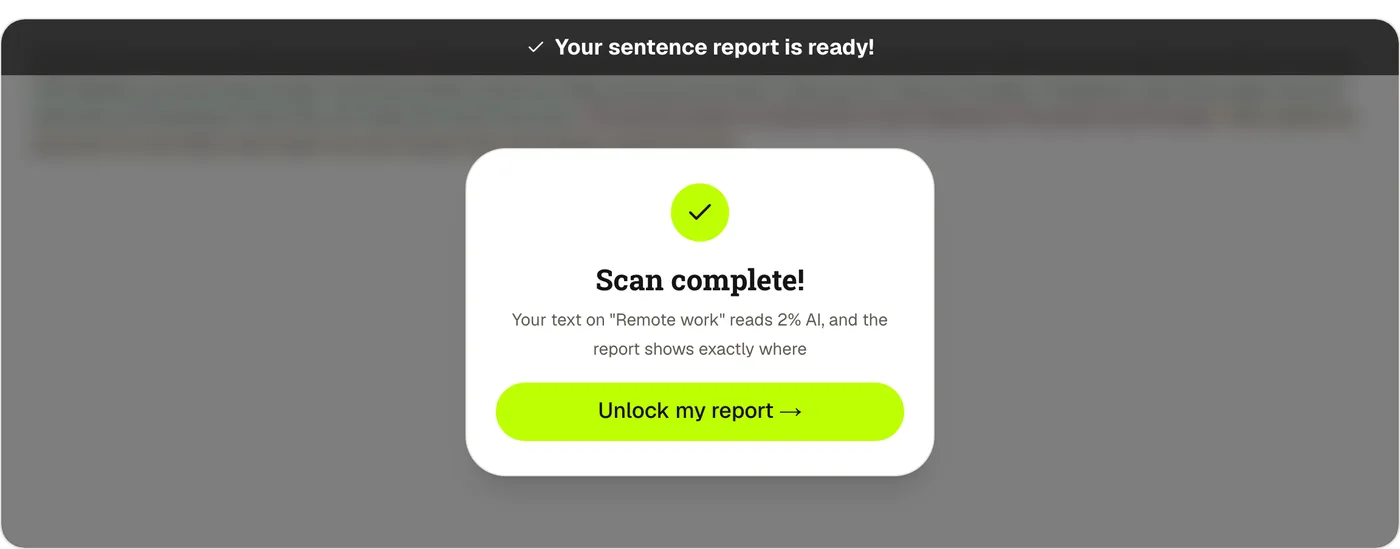
- Keep drafts and version history as process evidence. GPTZero's own guidance says "No detector is perfect" and recommends its Writing Replay for that kind of record. A document history or a local file trail does the same job, and process evidence is what a fair reader can actually inspect.
Readers who want the wider bench can start with the best AI humanizer ranking. I would still scan before and after, on more than one detector.
FAQ
Can GPTZero prove that someone used AI?
Why did GPTZero call my essay 100% AI when I wrote it myself?
Does GPTZero detect ChatGPT?
Can GPTZero catch paraphrased or humanized AI?
Is GPTZero biased against non-native English writers?
What is GPTZero Writing Replay?
Who owns GPTZero?
So, is GPTZero accurate?
GPTZero is accurate on raw machine text and it flags formal human prose often enough that I wouldn't let a single percentage decide a grade, an application, or a job. Look closer, get a second read, and keep the drafts.
Check the text before anyone else does.
Free scan, sentence-level marks, no card. If something flags, humanize those lines and scan again.